Cloud
Access your data securely from anywhere with public, private and hybrid cloud solutions, and run your business more efficiently.
Bu sayfa Türkçe olarak da mevcut.

What Is Factorbooks?
Factorbooks® is cloud-based Autonomous Enterprise Resource Planning (ERP) software, powered by AI and automation, that brings business processes including finance, accounting, sales, purchasing, production and human resources together on one platform.
Factorbooks® Autonomous Business Management (ABM) is a management system, supported by artificial intelligence (AI) and advanced technology infrastructure, that runs a company's operational and management processes with minimal human intervention. It enables robotic process automation (RPA) of complex processes, faster decision making through a Decision Support System (DSS), and data-driven strategic management.
Companies use Factorbooks® to simplify daily management tasks, improve efficiency and grow sustainably. Autonomous systems let business processes run faster and more securely; they reduce human error, improve resource management and let people focus on strategic work.
Enterprise Resource Planning (ERP) systems are software systems developed since the 1970s to handle the core functions of growing businesses, built with the technologies of their time.
Autonomous Business Management (ABM) is an advanced engineering effort designed with the technological innovations of recent years, above all AI and cloud computing. While ERP systems provide core functions, ABM aims to manage a company's functions autonomously, end to end.
Compare the ERP and ABM packages
"Autonomous Business Management (ABM) is a revolutionary approach that automates and optimizes companies' operational processes with AI-powered systems and raises efficiency."

Access your data securely from anywhere with public, private and hybrid cloud solutions, and run your business more efficiently.
With its modular structure, easily manage all your business processes on a single platform to boost efficiency and gain operational flexibility.
Provides a continuously monitored infrastructure secured with advanced security (OWASP Level 2) protocols to protect your data.
With TOGAF 10 architecture, it aligns your business processes and technology infrastructure with your strategic goals to increase your efficiency.
AI-powered ERP analyzes your data to speed up decision-making, automate processes and increase efficiency.
Automates repetitive work, reduces errors and helps get more done in less time.
Its scalable structure expands easily as your business grows and adapts quickly to your evolving needs.
Role-based ERP provides access tailored to your employees' duties and permissions, improving security and operational effectiveness.
Delivers cost savings and efficiency, offering budget-friendly solutions for your business and optimizing resource use.
The Factorbooks ERP application is cloud-based (SaaS) and gives businesses secure access from anywhere.
Frees the business from the risk of depending on specific people, creating a more flexible and efficient structure.
Plans and manages all business processes with AI algorithms, increasing operational efficiency.
Tracks planned business processes, reports the status of process flows online and creates action plans.
Through automation, routine tasks and transactions are carried out without human intervention, saving labor and time. This significantly lowers businesses' operational costs.
Human errors are minimized, improving the accuracy and reliability of processes.
Advanced data analytics and AI give businesses the ability to make timely and accurate decisions.
Automating business processes enables operations to run faster and more efficiently.
Factorbooks systems enable businesses to adapt quickly to changing conditions and to grow. Advanced flexibility allows operations to be adjusted to different business volumes and needs.
Works in line with the Tax Procedure Law (VUK) and helps prevent unnecessary tax losses through tax optimization.
Automatically generates accounting data from commercial and financial data and prepares financial statements.
Through tax optimization, it makes use of all the opportunities the law provides and prevents tax losses.
Performs tax planning and shows tax payments in the projected pro forma cash flow.
Information such as the company's liquidity position, profitability analysis and the monthly breakdown of working capital can be monitored continuously and in real time through charts.
Tasks such as inflation accounting are performed automatically by the system every month.
Affiliate, subsidiary and consolidation structures are available, and consolidated financial statements are generated automatically.
Monitors the company's operational processes, reports inefficiencies and drives improvement.
Plans the collection process, completes collections in full when due and improves liquidity.
Puts overdue accounts under follow-up. Alerts the debtor via email, SMS or phone call and directs the account to collection. Automatically creates the late payment difference invoice.
Works with multiple currencies and can produce reports in any currency you choose.
Collects and analyzes all of a business's data to proactively anticipate issues that may arise in business processes.
Advanced AI models guide businesses in their decision-making and recommend the best strategy for various scenarios.
Automates routine workflows so employees can focus on more strategic tasks.
Supports long-term strategic planning by accurately forecasting market trends, customer demand and operational outcomes.
Factorbooks® systems learn from user interactions and historical data to continuously optimize business processes.
The Factorbooks® infrastructure runs on a cloud-based system (public, private and hybrid cloud) and advanced data processing platforms. These systems are supported by modern technologies such as big data analytics, machine learning, robotic process automation (RPA) and the Internet of Things (IoT).
Factorbooks® Autonomous ERP technology was launched in 2010 as an R&D project supported by TÜBİTAK, the Scientific and Technological Research Council of Türkiye. The platform has been developed continuously since then. The Factorbooks® Digital Business Platform architecture integrates a set of disciplines to raise the efficiency of commercial businesses.
Using cloud computing services to store, process and share data effectively.
Integrating machine learning to strengthen data analytics and predictive capabilities.
Using AI to enable the platform to make smart decisions and automate complex tasks.
Business process automation technology that automates repetitive, rule-based tasks and speeds up business processes.
Provides the infrastructure needed to collect, process and make sense of information from different data sources.
The software foundation that forms the basis of the core system platform and enables automated operation.
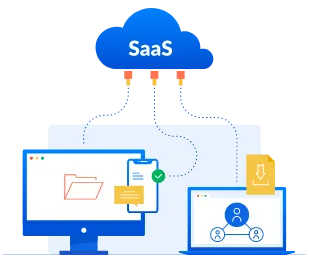
"Software as a Service": software delivered as a service, offering easy access and updates.
Integrating financial solutions through the Embedded Finance feature. While the Factorbooks® Digital Business Platform is classified as Software as a Service (SaaS), the Embedded Finance feature of its ERP application also places it in the Banking-as-a-Service (BaaS) category. This ERP solution, which optimizes business processes by reducing manual entry, can create exception transactions with user approval based on Natural Language Processing (NLP) or AI/Machine Learning (AI/ML) recommendations.
The Factorbooks business model aims to offer the autonomous ERP application, running on a SaaS cloud services platform, to commercial businesses and to build a "Commercial Digital Ecosystem" (CDE).
The ecosystem consists of a connected modular structure that runs with minimal human involvement, effective technology and value-creating algorithms. Roles in the company evolve toward a model where technology takes over routine tasks and employees focus on more strategic responsibilities.
Factorbooks' autonomous accounting capabilities use AI to record the accounting entries arising from a company's commercial transactions automatically. The system records transactions online in line with the Turkish uniform chart of accounts, which speeds up accounting and lowers the risk of errors.
You can view automatically generated financial documents such as the chart of accounts, trial balance, balance sheet, financial statements and tax returns in real time in the application. When needed, you can create online reports to share with financial advisors, auditors or banks for credit applications.
Embedded finance solutions make financial processes a direct part of business operations. Financial transactions such as payment infrastructure, lending services and cash flow management run on a single platform.
Companies send and receive official documents such as e-Invoice, e-Archive and e-Ledger from within the application, integrated online with e-Transformation services and without separate middleware; accounting entries are created automatically.
Payments, loan management, cash flow tracking and other financial services come together in one system. Integration with multiple banks lets you manage banking transactions from one platform and get instant reports on bank accounts and transactions.
Inventory tracking, order management and payment integrations are managed in one system. Marketplace integration syncs with platforms such as Trendyol, Amazon and Hepsiburada to bring your products to a wide audience.
With real-time reports and in-depth analysis, companies monitor their operational efficiency. Financial and operational data is tracked on dashboards, and metrics such as revenue, expenses, profitability and cash flow are analyzed regularly.
The Factorbooks SaaS model frees companies from expensive hardware investments and time-consuming maintenance. Thanks to the cloud-based architecture, business processes can be managed from anywhere with internet access, and the system infrastructure is kept up to date.
With the banking-as-a-service business model and technology, companies can access banks' financial products and services from within the application. With open banking infrastructure, services such as payments, loan management and cash flow can run through Factorbooks.
Factorbooks® is equipped with advanced security systems to protect data and business processes. The platform is designed around the TOGAF 10 enterprise architecture standard, the COBIT 5 IT governance framework, the ISO 27001 Information Security Management System, OWASP web security, centralized log management with SIEM (security information and event management) for enterprises, and the personal data protection requirements of KVKK and GDPR.

Strong encryption methods are used for all sensitive data, communications and storage. This helps protect data against unauthorized access.
Users access the system through strong, unique authentication methods. This prevents unauthorized access.
Firewalls are used to strengthen network security. This provides an additional layer of defense against malicious attacks.
Software and security patches are updated regularly. This helps us close known vulnerabilities.
Activity in the system is monitored and logged. This helps us detect and respond to potential threats.
User access levels are limited to what is necessary. Access is granted only to the data and functions that are required.
Data is backed up regularly and the backups are stored securely. Measures are taken to prevent data loss.
Staff are trained to follow security protocols and to raise security awareness.
See Factorbooks in a live demo using your own business processes.
info@factorbooks.com
Write your question and our sales team will get back to you.
Let’s walk through your processes together in a live demo.
Address, map and working hours.